How to read your astrocartography report
Your astrocartography report turns your map into pages: your lines, the cities near them, the places ranked for your chart and the dates when they come into focus. Start with the contents page and its "How to read your lines" box, then open the page that answers your question. This guide explains every section of the free report, the Personal Atlas and the Birthday Atlas.
What your report is
Every report on this site is made in your browser from your date, time and place of birth. It uses the same engine as the map and the same texts as the line pages, chosen and combined for your chart. Your birth details and cities stay on your device.
There are three reports. The free report is 11 pages. The Personal Atlas, the full report, grows with the cities you add: the public sample, with five cities and a home city, runs to 68 pages. The Birthday Atlas is about 22 pages. All three share a cover, a contents page, a method page and the same way of drawing lines, so once you can read one, you can read the others.
Start with the contents page
Page 2 of every report is called "What this report shows". It lists the sections in order, and below the list sits a box headed "How to read your lines". Read that box first: it explains the four kinds of line in a few sentences and reminds you that nobody's life is decided by a line. Then go straight to the page that answers your question.
| Your question | The page to open | In which report |
|---|---|---|
| Where in the world fits me best? | Your 20 best places in the world, ranked | Personal Atlas (names hidden in the free report) |
| How does the city I live in now do? | Your home now | Personal Atlas |
| Which of my cities should I pick? | Which city? Your verdict | Personal Atlas |
| When should I go? | Best dates for each of your cities | Personal Atlas, Birthday Atlas |
| Where should I spend my birthday? | Your 10 best cities for this birthday | Birthday Atlas |
| What does one line mean for me? | Your lines, read in full | Personal Atlas (one line in the free report) |
The distances your report uses
Astrologers do not agree on one distance for a line, and our map reading guide explains why. A report still has to draw the line somewhere, so ours uses a few fixed numbers, the same on every page:
- 150 km: the free report's "Ten of your lines and the cities on them" lists only cities this close.
- 300 km: the best places lists, the tables of the biggest city near each line, crossings near a city, and the best-date windows (a moving planet's line within 300 km of your city).
- 400 km (250 mi): the city pages, the comparison table and the verdict. A line for a goal, or a line to handle with care, counts there only within 400 km.
- 700 km: past this, a line adds nothing to a city's score. A city on the line gets its full weight, a city 300 km away gets half.
"Large city" always means a city of over 250,000 people. There are about 2,450 of them in the list the report ranks, and the ranking pages give the exact count.
The free report, page by page
The free report shows where your lines run and gives one answer for each part of life. Its 11 pages, in order:
- Cover. Your name if you added one, and your birth date, time and place. Check these first: every line depends on them.
- What this report shows. The contents and the "How to read your lines" box.
- Your 40 lines around the world. Ten planets, four lines each, on a flat world map. The small circle is your birth place. Solid lines are MC and AC lines, dashed lines are IC and DC lines. Below the map, a table names the biggest city within 300 km of each planet's MC line and AC line. "Over ocean or thinly settled land" means no large city is that close.
- Your top place for each part of life. Five themes: love and partnership, career and recognition, home and family, confidence and a fresh start, and luck, learning and travel. For each, you get the biggest city within 300 km of a line astrologers connect with that theme (or the nearest one within 700 km), the line and its distance, and one sentence on why. Under the first three, a locked note counts the best-date windows to go there in the next two years; the dates themselves are in the Personal Atlas.
- Your 20 best places in the world, ranked. The Personal Atlas ranking with the city names hidden. You still see the themes behind each place and the region of your number one.
- Ten of your lines and the cities on them. The ten largest cities within 150 km of one of your lines, each with that line's "at a glance" reading.
- Where two of your lines cross. How many crossings your map has, and the three closest to a large city, each with what the pair of planets means.
- Your next 12 months. The exact passes: the days a moving planet reaches a planet of your birth chart. Astrologers say that planet's lines come into focus around the date. The Moon is left out because it passes every planet once a month.
- Your next birthday. Your solar return: the rising sign of the year, the house of the Sun (read as the main focus of the year) and the sign and house of the Moon.
- Go deeper. The line behind your top place for the first theme that has one, read in full (love, work, strengths and challenges), then a list of what the Personal Atlas adds for this chart.
- Back cover.
How to use it: read page 4 first, then look for cities you already know on pages 3 and 6. If a place you care about is not named anywhere, that does not make it a bad place: it may simply have no line close by. Search it on the map to see its nearest lines in kilometers.

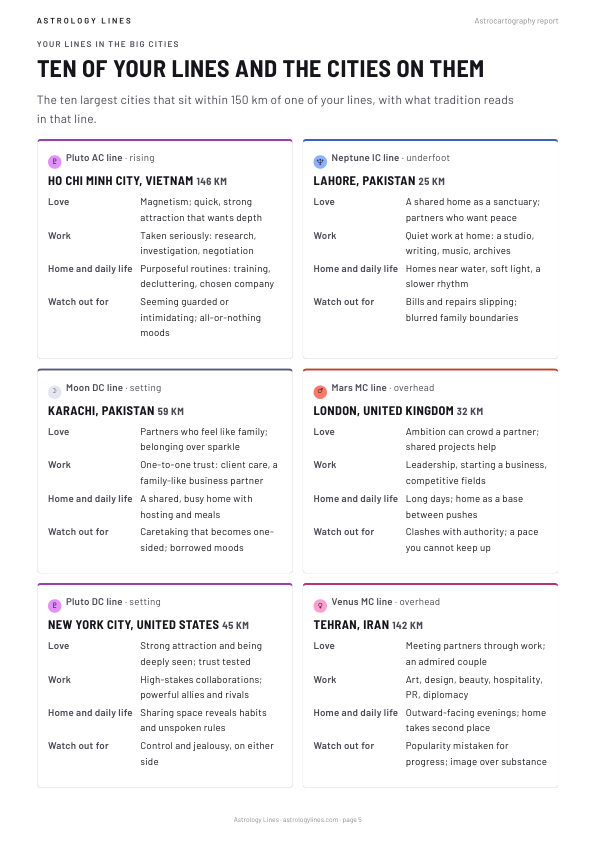
The samples on this page were made for the site's example chart: born in Paris on 14 July 1990, living in London.
The Personal Atlas, section by section
The Personal Atlas is the full report. It keeps the map and the top places of the free report (five cities per theme instead of one) and adds the ranking, your home, all 48 lines, your own cities, a verdict and two years of timing. The contents page lists only the sections your order includes: without a home city there is no "Your home now", and with a single city there is no comparison.
Your 20 best places in the world, ranked
This is the page most readers open first. The report scores every large city for your chart and lists the top 20, one per area (no two within 300 km of each other) and no more than three per country. In plain words, a city scores well when it sits close to a line astrologers connect with a part of life, and loses points when it sits close to a line to handle with care.
The score is worked out like this:
- For each of the five themes, the report takes the theme line that weighs most near the city. A line counts in full when the city is on it, half at 300 km and nothing past 700 km.
- Whose line it is matters too. Jupiter and Venus lines count fully (1.0), Sun lines 0.9, Moon lines 0.8, Mercury lines 0.7, and Mars and Uranus lines 0.6, because tradition reads those two as mixed blessings.
- The city's score is its best theme plus half of its second-best theme, minus most of the weight of the nearest line to handle with care.
- Bigger cities get a small lift that only breaks near-ties in the list. Your home and your own cities are compared on the lines alone.
Each row names the theme behind the place with the line and its distance. A grey note in brackets means a line to handle with care also runs nearby. A city near the top is a strong match on your lines and nothing more: as the page itself says, cost of living, safety, work and the people you love count as much as any line.
These are the lines each theme counts, the same in every section of the report:
| Theme | Lines the report counts |
|---|---|
| Love and partnership | Venus DC and AC, Jupiter DC, Sun DC, Moon DC |
| Career and recognition | Sun MC, Jupiter MC, Venus MC, Mercury MC, Mars MC |
| Home and family | Moon IC, Venus IC, Jupiter IC, Sun IC |
| Confidence and a fresh start | Sun AC, Jupiter AC, Venus AC, Mars AC |
| Luck, learning and travel | All four Jupiter lines, Mercury AC and DC, Uranus AC |
| Handle with care | All four Saturn and Pluto lines, Mars IC and DC, Neptune DC, Uranus IC and DC |
The best in each part of the world
Under the top 20, a table gives your three best cities in each of seven regions: Europe, North America, Latin America and the Caribbean, the Middle East and North Africa, Sub-Saharan Africa, Asia, and Oceania. Use it when your top 20 is crowded into one part of the world, or when you already know which continent you want.
Better places near home, and Your home now
If you entered where you live now, the ranking page adds up to five cities within 1,500 km that score higher than your home, and says where your home ranks among all the large cities. A page titled "Your home now" follows. It repeats the rank, says what your home has going for it, and lists up to three better places within 500 km. If none scores higher, it says so: for your lines, you already live in the best spot of your area. The rest of that page reads like a city page (below), with your home marked H on the map.
A low rank is not a warning. Most large cities have no strong line nearby, so most land somewhere in the middle. If no theme line is close enough to count, the page reads your home as neutral, its tone set by your relocated chart.
Your lines, read in full
Twelve sections, one each for the ten planets, the North Node and Chiron: 48 lines in all. Each section opens with the sign your planet was in at birth and a short reading of it, because tradition reads every line of that planet in that tone. A small map shows only that planet's four lines. Then each line gets a card: the biggest city within 300 km, the "at a glance" rows, love, work, daily life, and a list of strengths and challenges. These are the texts of the line pages on this site, so you can always open a line such as the Venus DC line for the full page with its questions and answers.
Your cities
Each city you chose (up to five) gets its own pages, headed "Your city 1 of 5" and so on. Read them top to bottom:
- The box at the top says what the city is best for: every theme with a line within 400 km, naming the line and its distance. If a line to handle with care runs within 400 km, the box names it too. If no theme line is that close, it reads the place as neutral.
- The lines closest to the city: up to four within 700 km, each with its short reading and a note on visiting.
- Line crossings nearby (within 600 km) and parans at this latitude (within 1 degree north or south), when there are any.
- Your chart in the city: your relocated chart wheel, your rising sign and Midheaven at birth and there, the planets that change house, and readings for up to three of them. It is the same idea as the relocation chart on the site.
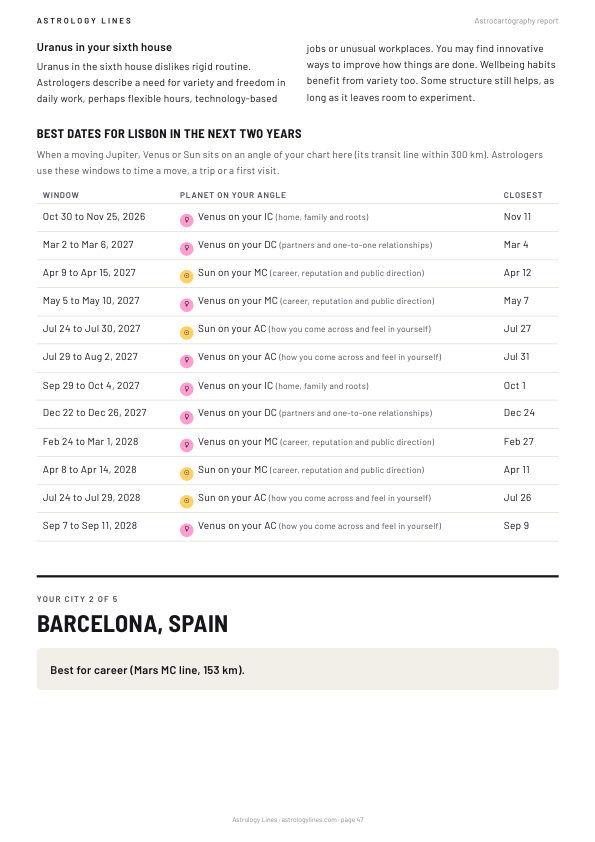
- Best dates in the next two years: windows when a moving Jupiter or Venus sits on any angle of your birth chart at that city, or the moving Sun on your MC or AC (its transit line within 300 km). The middle column names the planet and the angle, the last column the day it passes closest. "Or later" means the window is still open at the end of the two years. An empty table means no window falls in that time, which is common: the slow lines move only a few thousand kilometers a year.
Astrologers use these windows to time a move, a trip or a first visit. The reasoning is on best time to move.
Your cities compared
With two or more cities, one table puts them side by side: the nearest line of any kind, a Yes or No for each of the five themes, the line to handle with care, and your rising sign and Midheaven in each city. "Yes" means a line for that theme runs within 400 km (250 mi), and the small print names it.
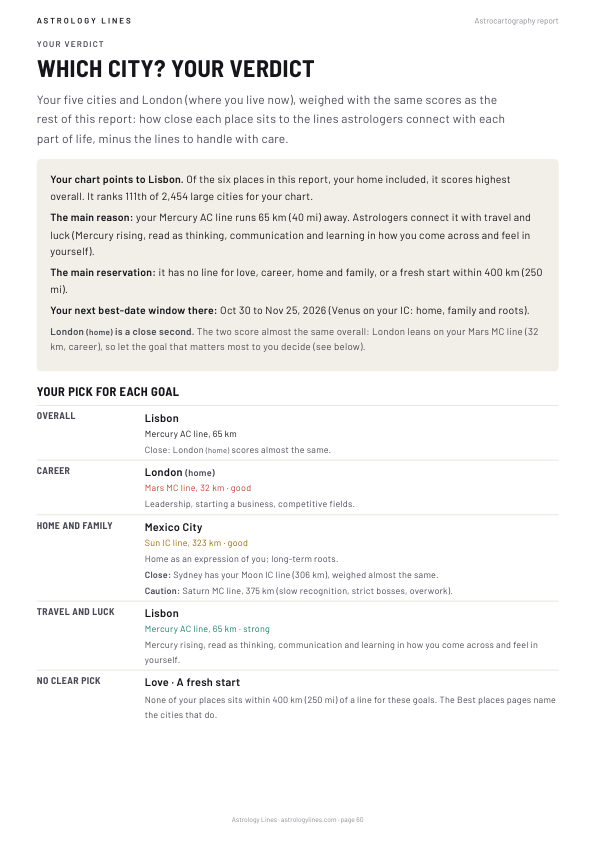
Which city? Your verdict
This page appears when your cities plus your home make at least two places (your home is left out if it is one of your cities). It adds no new rules: it says out loud what the other pages show. The overall pick is the place with the highest score, the same score as the world ranking.
The box at the top gives four things: the city your chart points to, the main reason (the line behind it), the main reservation (a line to handle with care, or the goals it has no line for) and your next best-date window there. If the top two score almost the same (a gap smaller than about 60 km on a Venus or Jupiter line), it calls the second a close second and tells you to let your most important goal decide. Under the box, "Your pick for each goal" names the best place for love, career, home and family, travel and luck, and a fresh start, with a caution where one applies. Goals that none of your places has a line for are grouped under "No clear pick".
The last table scores every place for every goal with dots:
| Mark | Dots | What it means |
|---|---|---|
| Strong | ●●● | A weight of 0.6 or more |
| Good | ●●○ | From 0.4 up to 0.6 |
| Mild | ●○○ | Above 0, below 0.4 |
| None | ○○○ | No line for that goal within 400 km (250 mi) |
The weight is the closeness times the planet's number, as in the ranking. Turned into distances, it works out roughly like this for the best line a place has for a goal:
| The goal's line | Strong within | Good within |
|---|---|---|
| Jupiter or Venus | about 240 km | about 380 km |
| Sun | about 200 km | about 340 km |
| Moon | about 150 km | about 300 km |
| Mercury | about 85 km | about 255 km |
| Mars or Uranus | only right on the line | about 200 km |
Anything farther, up to 400 km, is mild. In the "Handle with care" column, "close" means a care line within 200 km and "some" within 400 km. A verdict is your chart's lean, not an instruction; the page's own note puts it plainly: your chart points, it does not decide.
Line crossings, your birthday and timing
The crossings page shows up to 12 crossings that sit within 300 km of a city of over 250,000 people, closest first, each with its city and what the two planets mean together. The birthday page gives your next solar return, as in the free report, and adds your birthday map: cities within 250 km of the solar return lines of Jupiter and Venus and the Sun's MC and AC lines. The timing page lists two years of exact passes, each with the moving planet's keywords.
Method and your map wallpapers
The method page says how the positions were computed, which line method your report used (in the sky or on the ecliptic) and the honest limits. Your map wallpapers are not in the PDF: they sit at the top of the report on screen. Pick one of four designs (night sky, gold, paper, or my best lines, which brightens your love, career and luck lines) and a size for a phone, tablet or computer. The globe is centered on your number one place, and your birth date appears only if you tick the box.
The Birthday Atlas, section by section
The Birthday Atlas is about one year: your next birthday and the twelve months from now. It uses two kinds of lines. Solar return lines show where each planet sat on an angle at the moment of your birthday. Transit lines show where the planets moving through the sky each month fall on the angles of your birth chart.
Your solar return
Once a year the Sun comes back to the exact degree it held at your birth. The report gives that moment to the minute, in the time zone of your birth place, and tells you when it falls on a different day from your calendar birthday. The chart is drawn for your birth place, with what stands out: the rising sign of the year, the house of the Sun (read as the main focus), the sign and house of the Moon, the Midheaven, and any planet within 5 degrees of an angle, read as one of the strongest voices of the year. Readings follow for the houses of the Sun, Moon, Venus, Mars and Jupiter. You can draw the same chart on the solar return page.
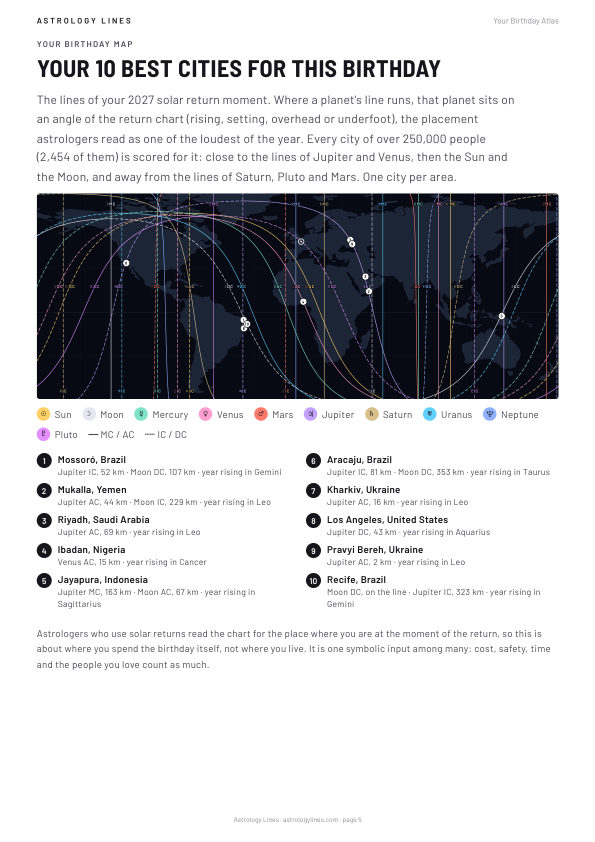
Your 10 best cities for this birthday
Astrologers who use solar returns read the chart for the place where you are at the moment of the return, so this ranking is about where you spend the birthday itself, not where you live. Every large city is scored on your solar return lines: Jupiter and Venus count most (1.0), then the Sun (0.9) and the Moon (0.7), with the same distance rule as the Personal Atlas, minus the nearest Saturn, Pluto or Mars line. Each row gives the lines behind it and the year's rising sign if you spent the birthday there.
Your birthday, region by region
The two best cities in each of the seven regions, how your home city ranks for this birthday (with better places within 1,500 km), and a table of the biggest city near each planet's MC and AC lines of the return.
The year at a glance and the 12 month pages
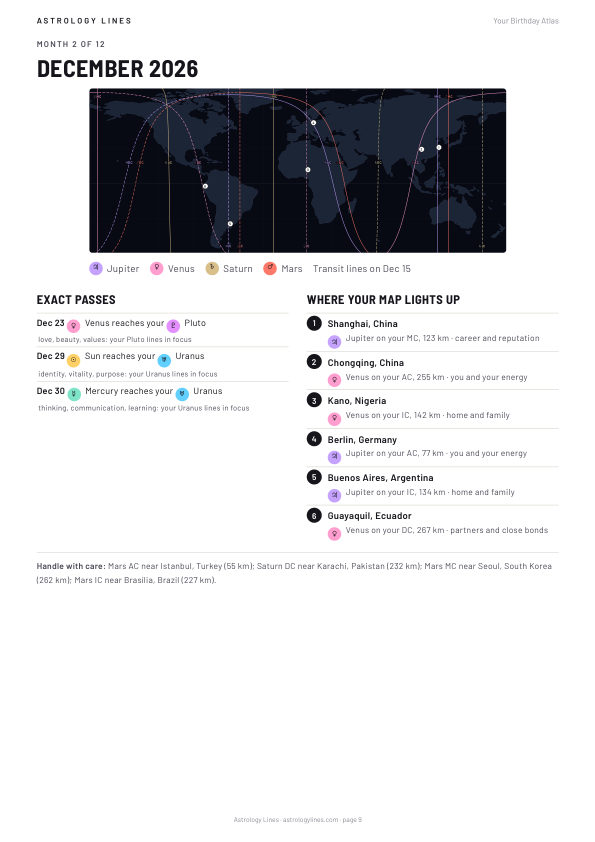
A table lists each month with its number of exact passes and the cities where your map lights up. Then comes one page per month (if fewer than 10 days are left in the current month, the twelve start with the next one). A box called "How to read the month pages" explains their three parts:
- Exact passes: the day a moving planet reaches one of your birth planets, with what the moving planet brings. "Venus reaches your Pluto" means your Pluto lines are in focus around that date, with a Venus tone.
- Where your map lights up: the biggest city within 300 km of each Jupiter and Venus transit line in the middle of the month, the six largest listed. Jupiter's lines move slowly and stay for months; Venus's move fast and shift across the month.
- Handle with care: the same for Saturn and Mars transit lines, up to four cities. In the report's own words, these are not places to avoid but places where things may ask more of you.
The best dates for your cities
Up to three cities you chose, each with its rank for this birthday, the year's rising sign there and its windows in the next twelve months, found the same way as in the Personal Atlas.
Meanings that apply in every report
The four angles
- MC line (solid, straight): the planet overhead. Read as career, reputation and public direction.
- IC line (dashed, straight): the planet underfoot. Read as home, family and roots.
- AC line (solid, curved): the planet rising. Read as you: your manner, energy and how you feel in yourself.
- DC line (dashed, curved): the planet setting. Read as partners, close bonds and the people you meet.
Every line is a planet plus an angle: the planet says what kind of experience, the angle says which area of life. The map reading guide covers the symbols, colors and line styles in detail.
The planets in one line each
| Planet | What astrologers read in its lines |
|---|---|
| Sun | Visibility, confidence and purpose |
| Moon | Home, feelings and belonging |
| Mercury | Words, study and contacts |
| Venus | Love, beauty and ease |
| Mars | Drive, courage and friction |
| Jupiter | Opportunity, growth and generosity |
| Saturn | Structure, effort and commitment |
| Uranus | Change, freedom and surprise |
| Neptune | Imagination, ideals and haze |
| Pluto | Intensity, depth and power |
| North Node | Direction and meaningful meetings |
| Chiron | Sensitivity, healing and mentoring |
The maps and the rankings use the ten planets (40 lines). The North Node and Chiron appear in "Your lines, read in full", which is why the Personal Atlas reads 48 lines.
How close a line has to be
There is no single answer in the tradition: many astrologers give the most weight to places within a few hundred kilometers and see the effect fade with distance. Your report applies that idea with the fixed distances above. When a city sits near one of those limits, read it as a borderline case rather than a clear yes or no.
Lines, crossings and parans
A line is one planet on one angle. A crossing is a point where two lines meet: both planets were on an angle at the same moment there, so astrologers read their themes as meeting. A paran is the band of latitude that runs around the world through that crossing, read as a softer version of the same pair. The city pages list both.
Your birth time
The Earth turns 1 degree every 4 minutes, so a birth time 4 minutes off moves every line about 110 km (69 miles) at the equator, and a quarter of an hour moves them almost four degrees. If your time is rounded, read the distances in your report loosely and treat a city near one of the limits as uncertain. On the map, the uncertainty band shades the zone where each line could fall.
Do difficult lines ever work for you?
Someone asked us this, and it is a fair question: if Saturn or Pluto runs through the city you love, should you cross it off? The tradition's answer is no. A demanding line is read as a place that asks for effort, and effort is sometimes exactly what you went there for.
The lines your report calls "handle with care"
In the Personal Atlas: all four Saturn lines and all four Pluto lines, the Mars IC and Mars DC lines, the Neptune DC line, and the Uranus IC and Uranus DC lines. The Mars MC and Mars AC lines are not on the list; they count toward career and a fresh start. In the Birthday Atlas, the Saturn, Pluto and Mars lines of the solar return count against a birthday city, and the month pages flag the cities near Saturn and Mars transit lines.
Lines do not switch off
Your lines are drawn from the moment you were born, so they stay where they are. A good month does not erase a Saturn line, and a hard month does not erase a Venus line. What changes is what else is active at that place, and how you use it.
A care line is not a ban
The report never removes a city because of a care line. It takes part of the line's weight off the score and names it as the reservation, next to what the place is good for. Tradition reads Saturn lines as structure, effort and commitment, with respect earned over time; Pluto lines as depth, intensity and reinvention; Mars lines as drive and friction. Many people choose such places on purpose: to study, to train, to take on a demanding job, to finish a hard project or to rebuild after a big change. Each line page lists the strengths as well as the challenges.
Pick a good moment
Astrologers who time moves look for the weeks when a moving Jupiter or Venus falls on an angle of your chart at the place. Your reports show exactly that:
- In the Personal Atlas, the best dates table on a city's page lists the windows when moving Jupiter, Venus or the Sun sits on an angle there. A city on your Saturn line with a Jupiter window is traditionally read as easier to arrive in during that window.
- In the Birthday Atlas, check the month pages: when your city, or a city near it, appears under "Where your map lights up", a Jupiter or Venus transit line runs within 300 km that month.
- In every report, the exact passes show the days when moving Jupiter or Venus reaches your Saturn, Pluto or Mars. Astrologers read those days as that planet's lines coming into focus with a gentler planet's tone.
Go with a purpose, at a good moment, and give it time. Keep the line in proportion too: work, visas, cost of living, family and how a place feels when you are there count as much as anything on the map. Astrocartography is a symbolic tradition, not a science, and nothing in a report predicts events.
What to do next
- No report yet? Draw your free map, then get the free report (11 pages, free).
- Want the names, your own cities and the dates? The Personal Atlas is USD 19, one time, for one person, with up to five cities you can change any time.
- Planning a birthday trip or a year of travel? The Birthday Atlas is USD 12, one time.
- Not sure which? Compare them on the report page, or open the samples (PDF): free report, Personal Atlas, Birthday Atlas.
- Already have yours? Open it from your report page, and keep best places by theme and the line pages for your nearest lines open beside it.
Questions people ask
Why is my report different from another site's astrocartography report?
Three things move lines: the birth time, the line method (in the sky or on the ecliptic) and old time zone rules. Rankings differ even more, because every site picks its own distances and weights. Ours are set out on this page and on your report's method page, so you can check any city yourself on the map.
Can I get a report without my birth time?
No. Lines depend on the hour, so the report asks for a birth time. With an approximate time it still works, but read the distances loosely. Without any time, the map can show your paran latitudes instead of lines.
Can I change my cities after buying?
Yes. Open your report and tap Change cities: up to five for the Personal Atlas and up to three for the Birthday Atlas, as often as you like. Each paid report covers one birth chart. If you entered the wrong birth details, they can be corrected once, within 7 days of purchase.
How do I save my report as a PDF on a phone?
Tap Save as PDF at the top of the report. On a phone, choose Share, then Save to Files in the print window; on a computer, choose Save as PDF. Copy link or Email link reopens the report on any device. The link holds your birth details, so keep it private.
My number one place is somewhere I would never live. What now?
The ranking reads your lines only; it knows nothing about visas, cost or family. Look at the theme in that row, then find the same kind of line elsewhere: the best in each region, the better places near home, and your own cities with their verdict. A short trip is a low-stakes way to try a line.
Why does the city where I live rank so low?
Most large cities have no strong line nearby, so most land in the middle of the list. A low rank means few theme lines close to your home, not a warning. The Your home now page shows the lines that are there and any better places within 500 km.
Does a Saturn or Pluto line near my city mean I should not go?
No. The report names it as a reservation, not a ban, and still scores what the place is good for. Many people go to such a place with a clear purpose, and the best dates show the windows astrologers read as easier for arriving.
New: map wallpapers in your Personal Atlas
Keep your map: free report or Personal Atlas
Free report free
- Your 40 lines on the world map
- Your top city for love, career, home and travel
- Your next 12 months
- A preview of your 20 best places in the world
Personal Atlas the full report · USD 19
- Your 20 best places in the world, ranked
- Your 5 best cities each for love, career, home and travel
- Up to 5 cities you choose: which one to pick, and the best dates to go
- Your map wallpapers for your phone and computer
New · USD 12Your Birthday Atlas Your next birthday and your 12 months, place by place.
- Your 10 best cities for your next birthday, ranked
- Your year's chart, explained
- Month by month: where your map lights up
- Best dates this year for your cities
"I love this app. I have more insight on where to move next!"
"Amazing, thank you for providing this service"